Quick Cart
Subtotal: $0.00
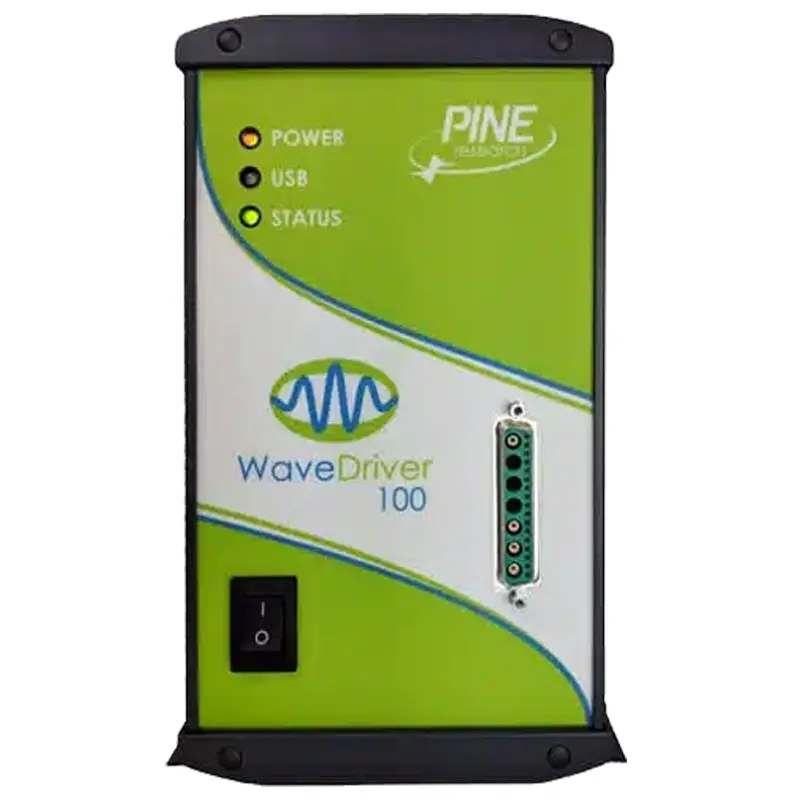
This WaveDriver® 100 Electrochemical Workstation is a versatile, research-grade, performance-driven system with potentiostat, galvanostat, EIS, open-circuit potential, and zero resistance ammeter modes of operation. It is engineered to provide the essential hardware and software features you need at an affordable price. This system finds use with stationary electrodes, rotating disk (RDE), and rotating cylinder (RCE) electrodes.
Under the control of our powerful AfterMath® Blue software package, the WaveDriver 100 supports a wide range of DC electroanalytical techniques as well as AC techniques like Electrochemical Impedance Spectroscopy (EIS). It offers current ranges up to ±1 A, potential ranges up to ±15 V, advanced inputs/outputs, waveform filters, EIS up to 1 MHz, and iR compensation.
The WaveDriver 100 is a trusted companion to our popular electrode rotators, including our latest evoLUTION, the MSR evo Electrode Rotator.
The WaveDriver 100 Electrochemical Workstation is engineered to provide the essential hardware and software features you need at an affordable price. It supports a wide range of DC electroanalytical techniques as well as AC techniques such as Electrochemical Impedance Spectroscopy (EIS). It offers current ranges up to ±1 A, potential ranges up to ±15 V, advanced inputs/outputs, waveform filters, EIS up to 1 MHz, and iR compensation. The WaveDriver 100 is a high performance, single-channel, EIS-capable workstation ideal for use with stationary electrodes, RDE, and RCE experiments.
Licenses for our AfterMath® Blue software are included with the purchase of an Electrochemical Workstation. The licenses give you access to all of the AC and DC methods that the WaveDriver 100 can perform. Pine Research does not charge extra for various categories of electrochemical techniques. If the instrument is capable of a method, you have access to it (no hidden costs). Here are some unique features of AfterMath Blue:
Our talented team of engineers and chemists have taken a careful approach at integrating EIS into our Electrochemical Workstations. Our software engineering team has incorporated EIS equivalent circuit fitting and simulation directly into our AfterMath Blue software (no separate software required). Multiple curve fitting algorithms and options allow you to fit even the most troublesome data. Here are some of the exciting and novel EIS analysis features in AfterMath Blue: