Quick Cart
Subtotal: $0.00

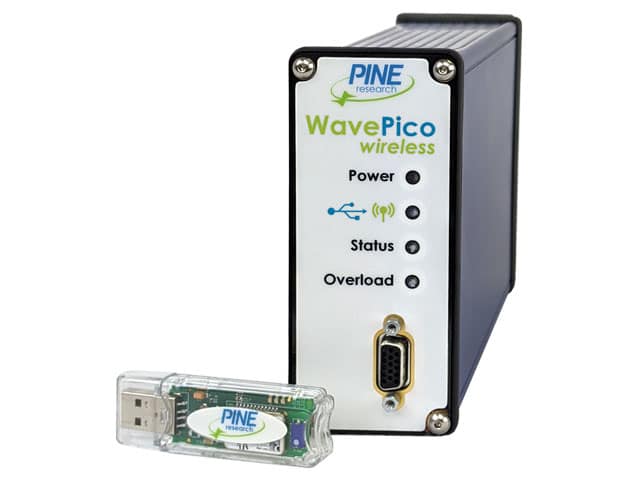
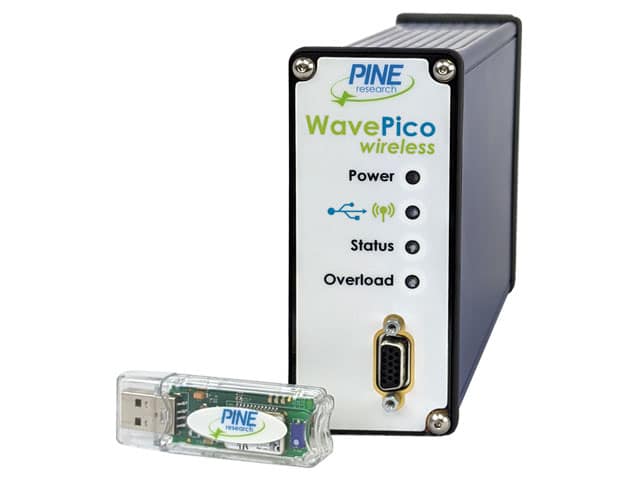
This new addition to our WaveNow® electrochemical workstation series lets you enjoy the freedom of controlling your electrochemical experiments wirelessly! This system also offers the lowest current resolution offered by Pine Research (practical range lower current is 40 fA), making the WavePico Wireless your trusted workstation for low current measurements, including for applications like biosensors. The WavePico Wireless electrochemical workstation is a potentiostat/galvanostat that gives you portability and access to remote lab spaces without creating a cabling problem. This is the perfect system for use in a glovebox – simply put the entire instrument into the glovebox along with your electrochemical cell and conduct your air-sensitive voltammetry experiments from any nearby computer. Under the control of our powerful AfterMath® Blue software package, the WavePico Wireless is capable of performing a wide variety of popular DC electroanalytical techniques. Start enjoying the benefits of wireless control and ultra-low current measurements today!
The WavePico Wireless Electrochemical Workstation is engineered to provide the essential hardware and software features you need at an affordable price. It supports a wide range of DC electroanalytical techniques. It offers current ranges up to ±1.5 mA and practical measurements down to ±40 fA, potential ranges up to ±8 V, wireless communication, waveform filters, and iR compensation. The WavePico Wireless is a capable yet cost-effective workstation, which is ideal for use with stationary electrodes, RDE, and RCE. Due to its wireless capability, it is especially useful for glovebox-based electrochemistry, or other conditions where having a cable between computer and workstation is inconvenient. The impressive low current resolution (practical range ±40 fA to ±1.5 mA) of the WavePico Wireless makes it an excellent workstation for biosensing applications, where signals are often nanoamperes or less!
Licenses for our AfterMath® Blue software are included with the purchase of an Electrochemical Workstation. The licenses give you access to all of the DC methods that the WavePico Wireless can perform. Pine Research does not charge extra for various categories of electrochemical techniques. If the instrument is capable of a method, you have access to it (no hidden costs). Here are some unique features of AfterMath Blue: