Complete RRDE System Bundle: WaveDriver 200, MSR evo, E8R4 Series RRDE

Purchase this product bundle with confidence. The team at Pine Research ensures all components are compatible and designed to work together. This is a complete bundle of everything you need to get started with experiments today. This bundle includes:

This bundle is perfect for a new lab startup, adding a new methodology to your research program or industrial applications, and/or increasing electrochemical exerpiment capacity in your lab.

Product Information

Important Product Warnings and Notices

Specify Power Cord
This product requires a power cord to connect to AC mains. Please specify the plug style used in your region when you order this product. We stock a variety of power cords.
Includes Free Training Session!
Every purchase of a Pine Research electrochemical workstation includes a free one-hour online training session! Contact Pine Research to inquire about this free session.
Maximum Rotation Rate
All rotating electrodes, including RDE, RRDE, and RCE, have an assigned maximum rotation rate. The maximum rotation rate is specific to each electrode series. Do not exceed the maximum rotation rate when working with rotating electrodes.
Maximum Rotation Rate: 3000 RPM
Never exceed maximum rotation rate when working with rotating electrodes.
Compatibility Notice
Avoid using this reference electrode with the following: NH3 buffers, sulfides, perchlorates, non-aqueous/organic solvents, and alkaline solutions stronger than 0.1M OH–.
Chemical Compatibility Caution Notice
PEEK dissolves with long exposure to concentrated acids.
Fragile Material Warning
Platinum wire is fragile. While it can be formed into a shape, repeated bending will cause the wire to break. In almost all cases, this is irreversible and cannot be repaired. Do not bend platinum wire.
Tip: Product Similarity
The WaveDriver 100 is a single channel electrochemical workstation with EIS, whereas the WaveDriver 200 is a two-channel bipotentiostat electrochemical workstation with EIS. The WaveDriver 40 does not have EIS, and is a two-channel bipotentiostat. Other specifications are shared among all current models of the WaveDriver Series.

Additional Product Details

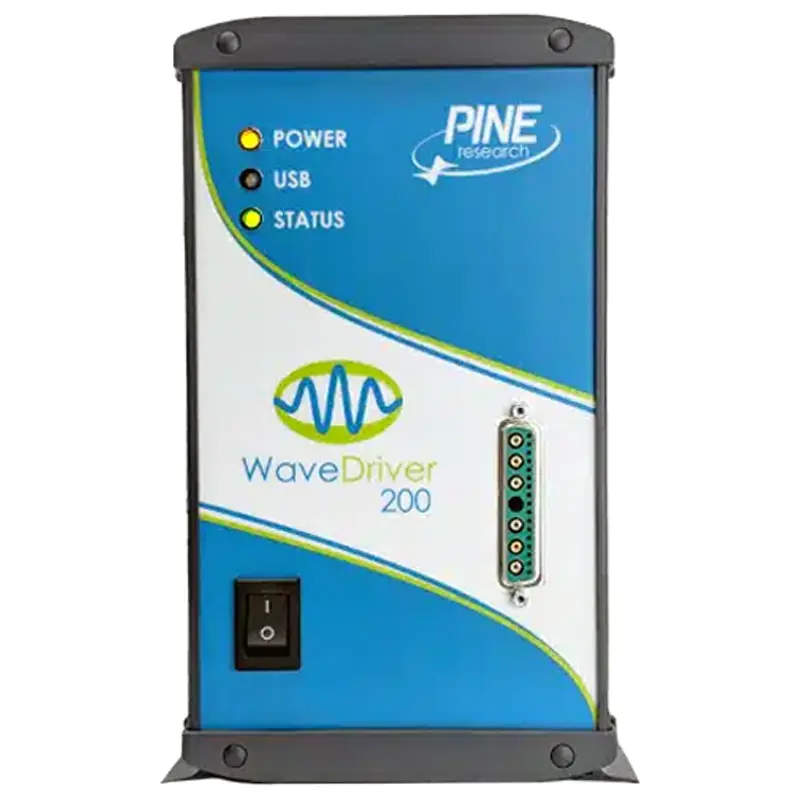
The WaveDriver 200 Electrochemical Workstation is an excellent choice. Unlike other "bipotentiostats" on the market, this workstation electronics features a truly integrated bipotentiostat. You do not have to mess around with cell cables in obscure configurations to operate the workstation as a bipotentiostat. It is ready to use out of the box - just connect your clearly-marked cell cable leads to the desired electrodes and you are ready to go with your experiment, like rotating ring-disk (RRDE). No additional cables, adapters, or connectors required.

The WaveDriver 200 Electrochemical Workstation is engineered to provide the essential hardware and software features you need at an affordable price. It supports a wide range of DC electroanalytical techniques as well as AC techniques such as Electrochemical Impedance Spectroscopy (EIS). It offers current ranges up to ±1 A, potential ranges up to ±15 V, advanced inputs/outputs, waveform filters, EIS up to 1 MHz, and iR compensation. The WaveDriver 200 is a high performance, EIS-capable workstation with integrated bipotentiostat, which is ideal for use with stationary electrodes, RDE, RRDE, and RCE.

AfterMath Blue - Data Acquisition, Analysis, and Organization Software

Licenses for our AfterMath® Blue software are included with the purchase of an Electrochemical Workstation. The licenses give you access to all of the AC and DC methods that the WaveDriver 200 can perform. Pine Research does not charge extra for various categories of electrochemical techniques. If the instrument is capable of a method, you have access to it (no hidden costs). Here are some unique features of AfterMath Blue:

  • Instrument Control. When started, AfterMath automatically detects all compatible instrumentation attached to the computer and provides complete control over each instrument. It can simultaneously control multiple instruments and queue multiple experiments.
  • Flexible Plotting. AfterMath offers a powerful "drag-n-drop" feature for quickly copying and moving traces between plots, with precise control over various plot settings.
  • Scientific Units. Designed with scientific data in mind, AfterMath properly handles units, metric prefixes, and significant figures.
  • Data Archiving. A unique XML-based file format allows multiple related experiments to be stored in a single archive file, simplifying file management.
  • Tools and Transforms. Flexible tools allow precise measurement of quantities like peak height and area, with fundamental mathematical operations available on any trace.

Our talented team of engineers and chemists have taken a careful approach at integrating EIS into our Electrochemical Workstations. Our software engineering team has incorporated EIS equivalent circuit fitting directly into our AfterMath Blue software (no separate software required). Multiple curve fitting algorithms and options allow you to fit even the most troublesome data. Here are some of the exciting and novel EIS analysis features in AfterMath Blue:

  • Integrated Curve Fitting and Analysis. Our software team has seamlessly integrated EIS curve fitting into AfterMath. Why work with more than one software application to fit your EIS data when you can do it using the very same software application that acquired the data? AfterMath EIS curve fitting utilities provide several analyses, including Circuit Fit, Transmission Line, and Kramers-Kronig. Unlike others, our fitting software also provides several fitting methods including Modified Levenberg-Marquardt (LM), Simplex, and Powell algorithms in addition to fitting options that include dynamic point selection, unity, and parametric fitting.
  • Novel Transmission Line Fitting. AfterMath provides a unique approach to model your porous electrodes. While the transmission line model is not new, AfterMath provides you with some unique transmission line fitting tools. Instead of a static circuit, where you have no control over the elements of the model, we provide a very flexible basic model, from which you can customize nearly all aspects of the model to suit your system. Give it a try - import your three- or five-column EIS data directly into AfterMath and see the difference with our transmission line fitting.
  • Finishing Touches. While fitting your EIS data, why flip back and forth between Nyquist and Bode plots? Why not be able to view both plots and fits simultaneously? We heard this feedback from many customers and have designed AfterMath to provide you with both plots simultaneously during fitting. You can also draw your own equivalent circuits to fit your particular system.

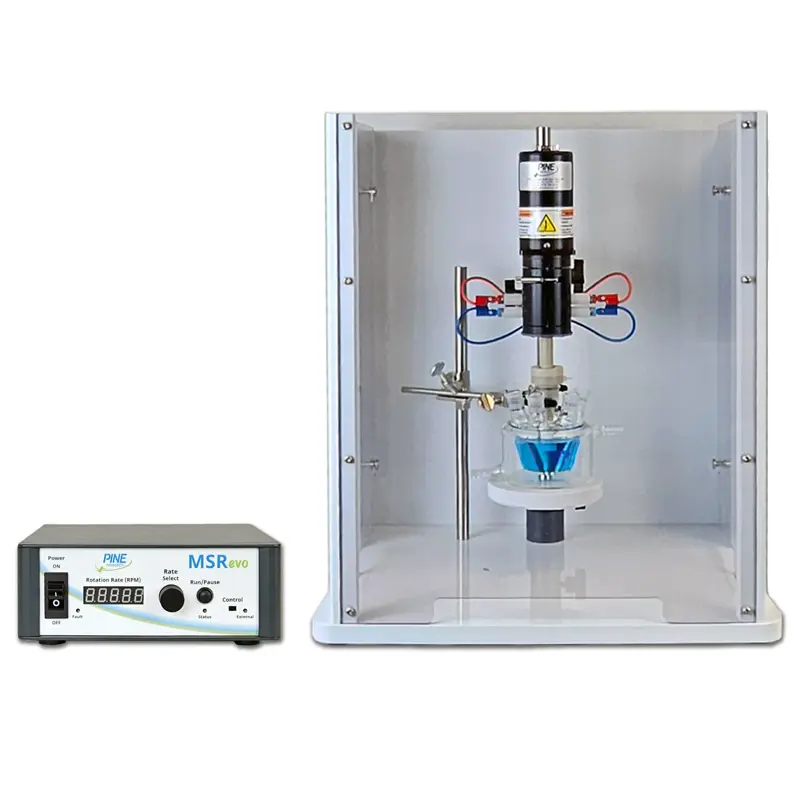
The MSR evo Electrode Rotator is an evoLUTION of the world's most popular rotator, the . This flexible electrochemical instrument may be used with Rotating Disk Electrodes (RDE), Rotating Ring-Disk Electrodes (RRDE), and Rotating Cylinder Electrodes (RCE). The MSR evo Rotator is compatible with most international power configuration standards. The MSR evo Rotator shares many of the same technical specifications as the MSR, with a few exciting updates:

  • Rotation range increase: 0 to 11,000 RPM
  • Improved and revised control unit electronics, for improved stability.
  • Updated control unit is smaller, modern, and better laid out.
  • Added Pause/Run button to front panel (as found on the ).
  • Bright LED display on front panel replaced old LCD.
  • Continues to use the same RDE, RRDE, and RCE electrodes as the original MSR.
  • New USB port on control unit allows for future integrations and features.

The rotation rate of the electrode may be adjusted using a control knob on the front panel of the motor control unit, or alternately, the rotation rate can be controlled via an output signal from an electrochemical workstation or third-party waveform generator. The rotation rate shines brightly on the new blue LED display on the control unit. The rotation rate is adjustable over a range from 50 to 10,800 RPM and is accurate to within 1% of the reading on the display. Rotation rate may also be monitored via an output signal proportional to the rotation rate, accesible on the control unit input/output connector.

The rotation rate may be controlled and modulated by a sine wave, square wave, or other externally generated waveform. The outstanding acceleration characteristics of the motor and its control circuitry allow the rotation rate to follow the control waveform with very little error. This feature is particularly desirable for techniques such as Hydrodynamic Modulation Voltammetry (HMV).

The rotator motor position is easily raised or lowered with respect to the cell platform, making immersion or removal of the rotating electrode tip quick and easy. The enclosure base is made from chemically resistant polypropylene, and the large enclosure window provides a good view of rotating electrode during operation.

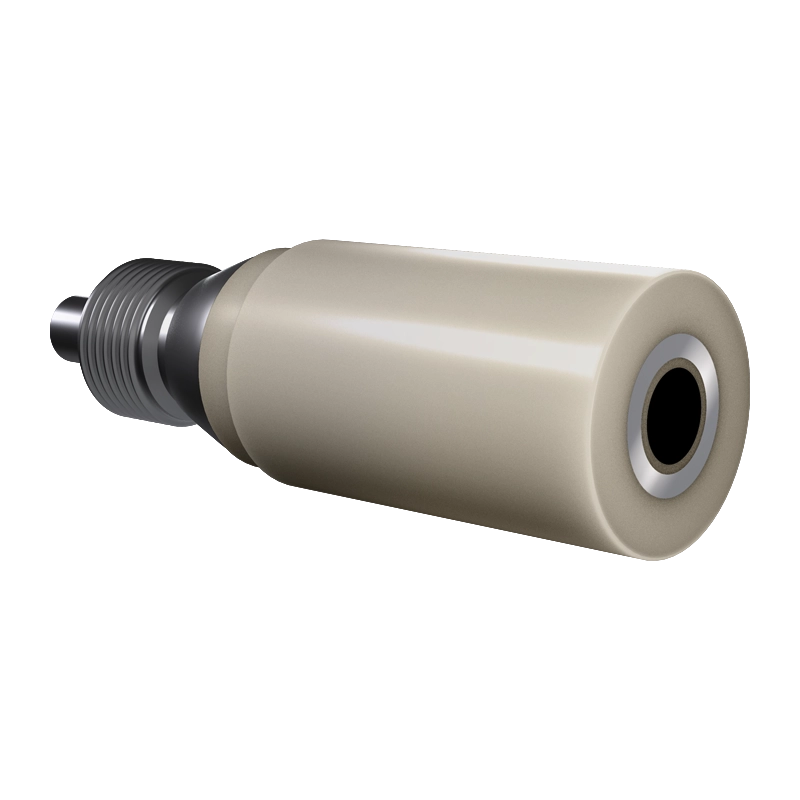
The E8R4 Series High Efficiency Rotating Ring-Disk Electrode (RRDE) with Platinum Ring and Glassy Carbon Disk has the highest collection efficiency of any RRDE electrode on the market, 43.9%! This tip features a 15 mm OD PEEK shroud, 5 mm OD glassy carbon disk, and 1.25 mm thick platinum ring. The tip threads into the Precision RDE/RRDE Shaft for E5, E5TQ, E6, E7, and E8 Series Tips, which is then installed into the MSR evo Electrode Rotator. Pine Research offers more electrode in more materials than anybody else. Check out all the other MSR evo compatible RRDE tips we offer.

Product Specifications

The specifications of this product, and any other product that may be included in a kit or bundle, or a part that is included with this product, are listed below.
Complete RRDE System Bundle: WaveDriver 200, MSR evo, E8R4 Series RRDE

Product Bundles

Product bundle
Yes
Bundle includes
Electrochemical workstation, Electrode rotator, Electrochemical cell, Reference electrode, Counter electrode, Rotating ring-disk working electrode, Cables, Rotating Shaft, Power Cord, AfterMath Blue Software
Bundle application
General electrochemistry, Education, Photoelectrochemistry, Rotating Disk (RDE), Rotating Ring-Disk (RRDE)
Bundled electrode rotator
MSR evo
Bundled electrochemical workstation
WaveDriver 200
Precision RDE/RRDE Shaft for E5, E5TQ, E6, E7, and E8 Series Tips View Product

Electrode Shafts

Shaft length (overall)
171 mm (6.7 in)
Shaft shroud diameter
15 mm
Shaft shroud length
83 mm, 101 mm
Shaft shroud material
PEEK
Shaft rotator compatibility
MSR Rotator (AFMSRCE), MSRX Rotator (AFMSRX), MSR evo Rotator (AFMSR24)
Shaft compatible electrode tip series
E5TQ (RDE tip), E6 (RRDE tip), E5 (RDE tip), E7 (RRDE tip), E8 (RRDE tip)

Electrode Rotator

Applications
Rotating application
Rotating Disk (RDE), Rotating Ring-Disk (RRDE)
E8 Series Fixed-Disk High Efficiency Rotating Ring-Disk Electrode, Glassy Carbon (GC) Disk, Platinum (Pt) Ring, PTFE separator, PEEK shroud View Product

Working Electrodes

Ring Electrodes
Ring material
Platinum (Pt)
Ring crystal lattice
Polycrystalline
Ring material purity
99.99%
Ring finish
Mirror Polish
Ring outer diameter
8.5 mm
Ring inner diameter
6 mm
Ring thickness
1.25 mm
Ring disk gap
0.5 mm
Ring disk separator material
PTFE
Collection efficiency
43.9%
Disk Electrodes
Disk electrode style
Fixed Disk
Disk material
Glassy Carbon (GC)
Disk crystal lattice
polycrystalline
Disk material purity
100%
Disk finish
Mirror Polish
Disk diameter
5 mm
Disk type
Fixed (embedded in electrode tip)
Disk series compatibility
None (Fixed Disk)
Electrode Tips
Tip maximum rotation rate
3000 RPM
Tip shroud material
PEEK
Tip shroud diameter
15 mm
Tip shroud length
25.4 mm
Tip length (overall)
49 mm
Rotating Electrodes
Maximum rotation rate
3000 RPM
Shaft compatibility
RDE/RRDE Precision Shaft for MSR Rotator (AFE6MB), RDE/RRDE Shaft for MSR Rotator (AFE6M), RDE/RRDE Shaft for WaveVortex 10 Rotator
Rotating electrode type
Fixed Disk Tip
Compatible electrode rotator(s)
ASR Rotator (AFASR), MSRX Rotator (AFMSRX), MSR Rotator (AFMSRCE), MSR evo Rotator (AFMSR24), WaveVortex 10 Rotator (AF01WV10)
General
Electrode series
E8
Thermal stability range
10°C - 80°C
Electrode use/application
Rotating Ring-Disk (RRDE)
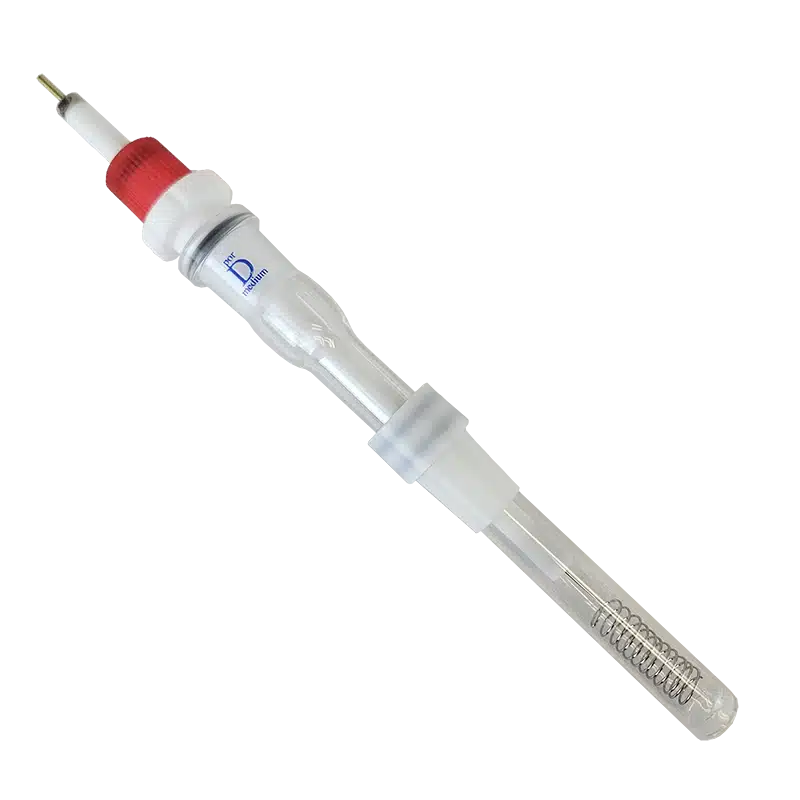
Reference Electrode, Silver/Silver Chloride, Single Junction View Product
Reference size type
Standard (9.5 mm OD)
Reference electrode body diameter
9.5 mm
Reference electrode length
19 cm
Reference frit material
Ceramic
External fill solution
4 M KCl with AgCl
Refillable
yes
Typical variance
±3 - 5 mV
Typical input impedance
< 10 kΩ
Reference electrode connection style
1.6 mm OD x 8.5 mm long brass pin
Reference electrode body material
borosilicate glass

Electrochemical Properties

Reference chemistry
Ag/AgCl
Standard potential
+199 mV vs NHE
Rotation Rate Control Interface Cable, for WaveVortex 10 and MSR evo Rotators, WaveDriver Series and WaveNow XV View Product

Cables

Cable type
Signal, Interface
Cable terminal A type
Plug, Terminal Block, Green, 3-pin
Cable terminal B type
Plug, Terminal Block, Green, 8-pin
Cable length
3 ft
Cable color
Gray
Cable instrument compatibility
WaveDriver series electrochemical workstation, WaveNow XV electrochemical workstation, MSR evo electrode rotator, WaveVortex 10 electrode rotator
WaveDriver 200/WaveDriver 40 Electrochemical Workstation Cell Cable View Product

Cables

Cable type
Workstation cell cable
Cable terminal A type
Plug, D-SUB 17-pin + 7 Coax
Cable length
3 ft
Cable color
Black
Cable instrument compatibility
WaveDriver 200 electrochemical workstation, WaveDriver 40 electrochemical workstation
Workstation Cell Cable
Number of cell cable leads
Seven (7)
Cell cable lead colors
Working 1 (drive) [RED], Working 1 (sense) [ORANGE], Counter/Auxiliary [GREEN], Reference [WHITE], Working 2 (sense) [VIOLET], Working 2 (drive) [BLUE], Instrument Chassis (ground) [GRAY]
Cell cable lead termination
Banana Plug (4 mm)
Cell cable shielded lines
Working 1 (drive), Working 1 (sense), Counter, Reference, Working 2 (sense), Working 2 (drive)
WaveDriver 40/100/200 Power Supply View Product

Workstation Compatibility

Compatible electrochemical workstation
WaveDriver 40 (AFP4), WaveDriver 100 (AFP5), WaveDriver 200 (AFP3)

Electrochemical Workstations

General
Power supply input
100 - 240 VAC, 1.4 - 0.7 A, 50 - 60 Hz
Power supply output
24 VDC, 5.0 A power supply (included) has a C14 type input connector
Power cord
Various international cables sold separately (C13 type)
Power Cords View Product

Power Cords

Plug style/country
United States, Canada, and Mexico, Continental Europe, United Kingdom, Denmark, Italy, Switzerland, China, Japan, Austrialia and New Zeland, South Africa, Israel, Argentina
Complete MSR Series Rotator Brush Assembly View Product

Brush Replacements

Brush housing color
Red, Blue, Yellow, Green
MSR Spring-Loaded Brush Assembly View Product
Counter Electrode Assembly, Platinum (Pt), 14/20 View Product

Counter Electrodes

Counter electrode size type
Standard (9.5 mm - 12 mm OD)
Counter body diameter
6.5 ± 0.5 mm (shroud)
Counter length
180 mm
Counter electrode material
Platinum Wire
Counter electrode connection style
1.5 mm OD x 7 mm long gold-plated pin
Counter electrode wire diameter
0.5 mm
Counter electrode wire surface area
4.7 cm²
Counter electrode platinum mass
1.3 g
Counter electrode adapter
6.4 mm to 14/20 Joint, 12 mm to 14/20 Joint
Counter electrode isolation tube frit
Ace Glass Frit D (10 – 20 µm)
Counter electrode isolation tube diameter
12 mm
Counter shroud material
Epoxy
WaveDriver 200 Electrochemical Workstation View Product

Electrode Rotator

Safety & Environmental
Rotator RoHS compliant
Yes
Rotator safety certification
CE, ETL

Electrochemical Workstations

Communication
Interface
USB
Wireless capable
No
General
Power input
24 VDC (±5%), 5.0 A (low voltage DC device)
Power supply input
100 - 240 VAC, 1.4 - 0.7 A, 50 - 60 Hz
Power supply output
24 VDC, 5.0 A power supply (included) has a C14 type input connector
Power cord
Various international cables sold separately (C13 type)
LED indicators
Power, USB, and status
Instrument dimensions
160 × 324 × 255 mm (6.3 × 12.75 × 10.0 in)
Workstation shipping dimensions
254 × 356 × 457 mm (10 × 14 × 18 in)
Instrument weight
4.6 kg (10.2 lb)
Workstation shipping weight
7.7 kg (17 lb)
Temperature range
10°C - 40°C
Humidity range
80% RH maximum, non-condensing
Workstation modes
Potentiostat (POT), Galvanostat (GAL), Open-Circuit Potential (OCP), Zero-Resistance Ammeter (ZRA)
Auxiliary Connections
Connector C
9-pin DSUB connector that includes DC Common, two digital output signals, and two digital input signals
Trigger input
BNC female, TTL compatible
Trigger output
BNC female, TTL compatible
Potential (E1) output
BNC female, ±15 V, ±10 V, ±2.5 V output, ±0.5% accuracy
Current (I1) output
BNC female, ±10 V output, scaled to current range, ±0.5% accuracy
Potential (E2) output
BNC female, ±15 V, ±10 V, ±2.5 V output, ±0.5% accuracy
Current (I2) output
BNC female, ±10 V output, scaled to current range, ±0.5% accuracy
Auxiliary analog input
BNC female, ±10 V differential input, 313 µV resolution, 0.2% accuracy (available when second working electrode not in use)
Auxiliary analog output
BNC female, ±10 V bipolar output, 313 µV resolution, 0.2% accuracy (available when second working electrode not in use)
WK1 input
BNC female, ±10V differential input, 20 kΩ impedance, ±0.5% accuracy; allows external waveform to be summed directly to the working electrode excitation signal
WK2 input
BNC female, ±10V differential input, 20 kΩ impedance, ±0.5% accuracy; allows external waveform to be summed directly to the working electrode excitation signal
Accessories
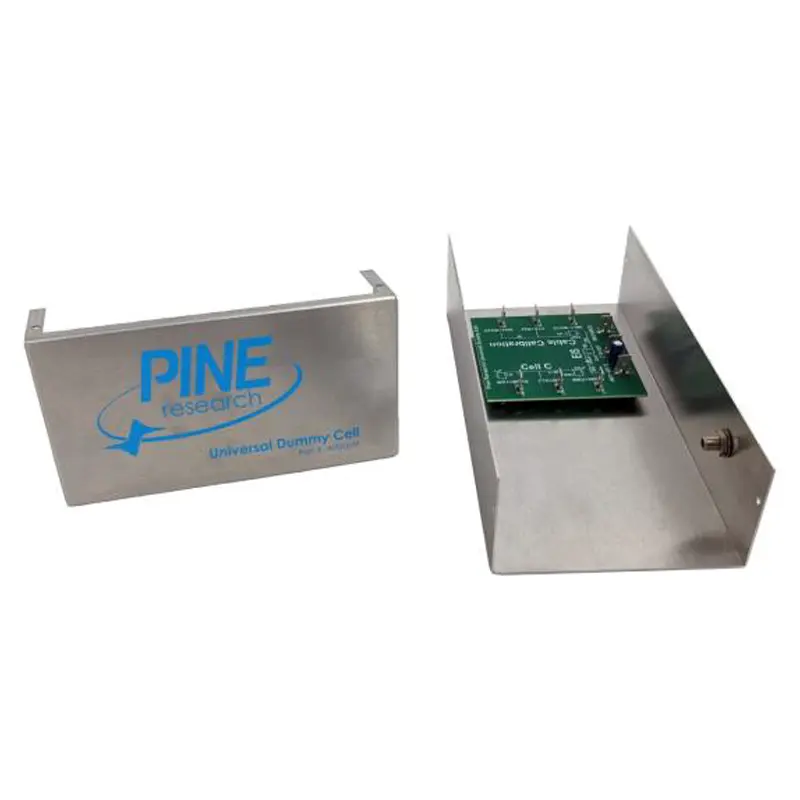
Dummy cell
External dummy cell included
Cell cable
Combination D-SUB connector to multiple banana plugs via shielded coaxial cables (included)
Rotator Control Connections
Rotator connector A
7-pin mini circular DIN includes analog and digital signal grounds, digital rotator enable signal (+15 V max), auxiliary digital output signal, and analog rotation rate control signal
Rotator connector B
3-pin connector includes analog signal ground, digital rotator enable signal (+15 V max), and analog rotation rate control signal
Rate control signal
±10 V, ±2.5 V
Digital enable signal
Open drain with 4.7 kΩ pull up to +5 V (TTL compatible)
Electrochemical Impedance Spectroscopy (EIS)
EIS capable
Yes
EIS frequency range
10 µHz - 1 MHz
EIS frequency resolution
<1 ppm 1 MHz - 100 mHz, <80 ppm 100 mHz - 10 mHz, <90 ppm 10 mHz - 1 mHz, <70 ppm 1 mHz - 10 µHz
EIS frequency stability
±10 ppm
Modes
Potentiostatic, Galvanostatic
Voltage excitation setpoint
1 mV - 200 mV peak, ±10% of setting
Current excitation setpoint
0.01% - 100% of current range, 10% of setting, 200 mA maximum
Frequency sweeping
Linear, Logarithmic, Custom list
EIS accuracy
EIS Accuracy Contour Plot
Data Acquisition (for DC Experiments)
Clock resolution
10 ns (minimum time base)
Point interval
80 µs (minimum)
Synchronization
Simultaneous sampling of all analog input signals
Raw point total
<10 million per experiment
Applied Potential (Potentiostatic Mode)
Potential ranges (applied)
±10 V, ±15 V, ±2.5 V
DC accuracy (potential, applied)
±0.2% of setting; ±0.05% of range
DAC output (potential)
16 bits
CV sweep rate (minimum)
10 µV/s
CV sweep rate (maximum)
75 V/s
Measured Potential
Potential ranges (measured)
±15 V, ±10 V, ±2.5 V
DC accuracy (potential, measured)
±0.2% of setting; ±0.05% of range
ADC output
16 bits
Filters (for DC Experiments)
100 kHz, 1 kHz, 100 Hz, 30 Hz, 10 Hz
Electrometer (Reference Electrode Amplifier)
Input impedance
>10¹² in parallel with <10 pF
Input current
<10 pA leakage/bias current at 25°C
CMRR
>100 dB, 0 - 1 kHz, >80 dB ≤10 kHz, >60 dB ≤100 kHz, >40 dB ≤ 1 MHz
Electrometer bandwidth
>15 MHz (3 dB)
Power Amplifier (Counter Electrode Amplifier)
Output current
±1 A (maximum)
Short circuit current limit
1A, 100 mA ranges: <1.3 A, 10 mA - 100 nA ranges: <200 mA
Compliance voltage
±17 V
Bandwidth
>2.5 MHz (on fastest speed setting)
Noise and ripple
<35 µV RMS in 2 MHz bandwidth
Slew rate/rise time
10 V/µs (on fastest speed setting)
Applied Current (Galvanostatic Mode)
Current ranges (applied)
±1 A, ±100 mA, ±10 mA, ±1 mA, ±100 µA, ±10 µA, ±1 µA, ±100 nA
DC accuracy (current, applied)
±0.2% of setting; ±0.05% of range
Measured Current (Potentiostatic Mode)
Current ranges (measured)
±1 A, ±100 mA, ±10 mA, ±1 mA, ±100 µA, ±10 µA, ±1 µA, ±100 nA
Current resolution at each range (measured)
31.3 µA, 3.13 µA, 313 nA, 31.3 nA, 3.13 nA, 313 pA, 31.3 pA, 3.13 pA
Autoranging
Yes
Practical current range
20 pA to 1 A
DC accuracy (current, measured)
±0.2% of setting; ±0.05% of range
DC leakage current
<10 pA at 25°C
AC accuracy (measured)
Frequency- and range-dependent to 1 MHz
AC leakage current
Frequency- and range-dependent to 1 MHz
ADC input
16 bits
Filters (for DC Experiments)
100 kHz, 1 kHz, 100 Hz, 30 Hz, 10 Hz
Ground Connections
DC common (signal)
The DC Common is isolated from the USB port, the instrument chassis and earth ground. The DC Common is accessible via a banana binding post (black) on the back panel.
Chassis terminal
The instrument chassis terminal is accessible via a banana binding post (metal) on the back panel. The GRAY banana plug on the cell cable also provides a chassis connection.
Earth
No direct connection to earth ground is provided.
Electrode Connections
Reference electrode
Sense line with driven shield
Counter electrode
Drive line with grounded shield
Working electrode channels
2 Channels
Working electrode #1 (WK1)
Separate sense and drive lines, each with driven shield (current measurement via passive shunt)
Working electrode #2 (WK2)
Separate sense and drive lines, each with driven shield (current measurement via transimpedance amplifier). Note: AC techniques are not available on WK2.
MSR evo Electrode Rotator View Product

Electrode Rotator

Safety & Environmental
Rotator RoHS compliant
Yes
Physical
Control unit dimensions
27 × 25 × 11 cm (10.8 × 9.8 × 4.3 in)
Enclosure dimensions
48 × 40 × 54 cm (18.8 × 15.5 × 21 in)
Enclosure base and sides materials
White polypropylene (PP)
Enclosure window material
Clear polycarbonate (PC)
Center post/support rod material
303 stainless steel
Operating temperature
10 °C - 40 °C (50 °F - 104 °F)
Rotator shipping weight
27 kg (60 lb)
Rotation Rate
Rate limits
0 to 11,000 RPM
Rate accuracy
0 to 4,000 RPM: accurate to within ±2 RPM; 4,000 RPM and above: accurate to within ±1 count and ±0.1% of display reading
External rate control
Optional rate control via input signal on external I/O port; available control ratios: 1, 2, or 4 RPM/mV, jumper selectable
Rate display
4 ½ digit display indicates rotation rate (RPM)
Rate output
Voltage output accessible from back panel 8-pin connector
Start/stop (front panel)
Push-button toggle on front panel with LED indicators for “pause” and “run”
Start/stop (external)
Optional digital motor stop input signal on external I/O port, Available TTL logic: active high or active low; jumper selectable, Front panel LED indicates when external motor stop is active
Grounding
Rotator chassis terminal
Chassis connection on back panel 8-pin connector
Rotator earth ground
No direct connection available
Electrical
Electrode connections
Disk electrode: two red banana jacks on motor unit, Ring electrode: two blue banana jacks on motor unit
Rotator AC power input
100 - 240 VAC, ±10%, 50/60 Hz, 2 A
Power switch location
Front of control unit
Back panel controls
Circuit breaker reset button, 8-pin I/O connector
Front panel controls
Power switch, External/manual control switch, Run/pause button
Rotator I/O Connections
External stop signal, External voltage input (external rate control), Voltage output, Chassis ground, TTL logic (active high or active low)
Motor
Control method
Closed loop servo-system; temperature compensated tachometer mounted on motor shaft
Maximum continuous torque
30.4 mN·m
Motor power
20 W
Motor protection
2 Amp thermal-type circuit breaker current limited power supplies
Motor type
Permanent Magnet
Modulation boundaries
Modulation boundaries plot

Replacement Parts & Accessories

The products shown below are included with Complete RRDE System Bundle: WaveDriver 200, MSR evo, E8R4 Series RRDE. We provide these listings so that customers may order replacement or additional components of this product. Should you want more details or wish to order an additional part, refer to the list below.

Product Documentation

Historically, much of our support content was written and published as PDF documents. We are primarily writing new support content as part of our Support Center instead; however, product user guides are still published in this format and not all historical application notes and other support documents have been migrated to the Support Center yet.

Safety Data Sheets (SDS)

If this product contains products where an SDS sheet is available, it will be displayed below.

Carbon Materials

Glassy Carbon (GC)

Electrode Polishing Materials

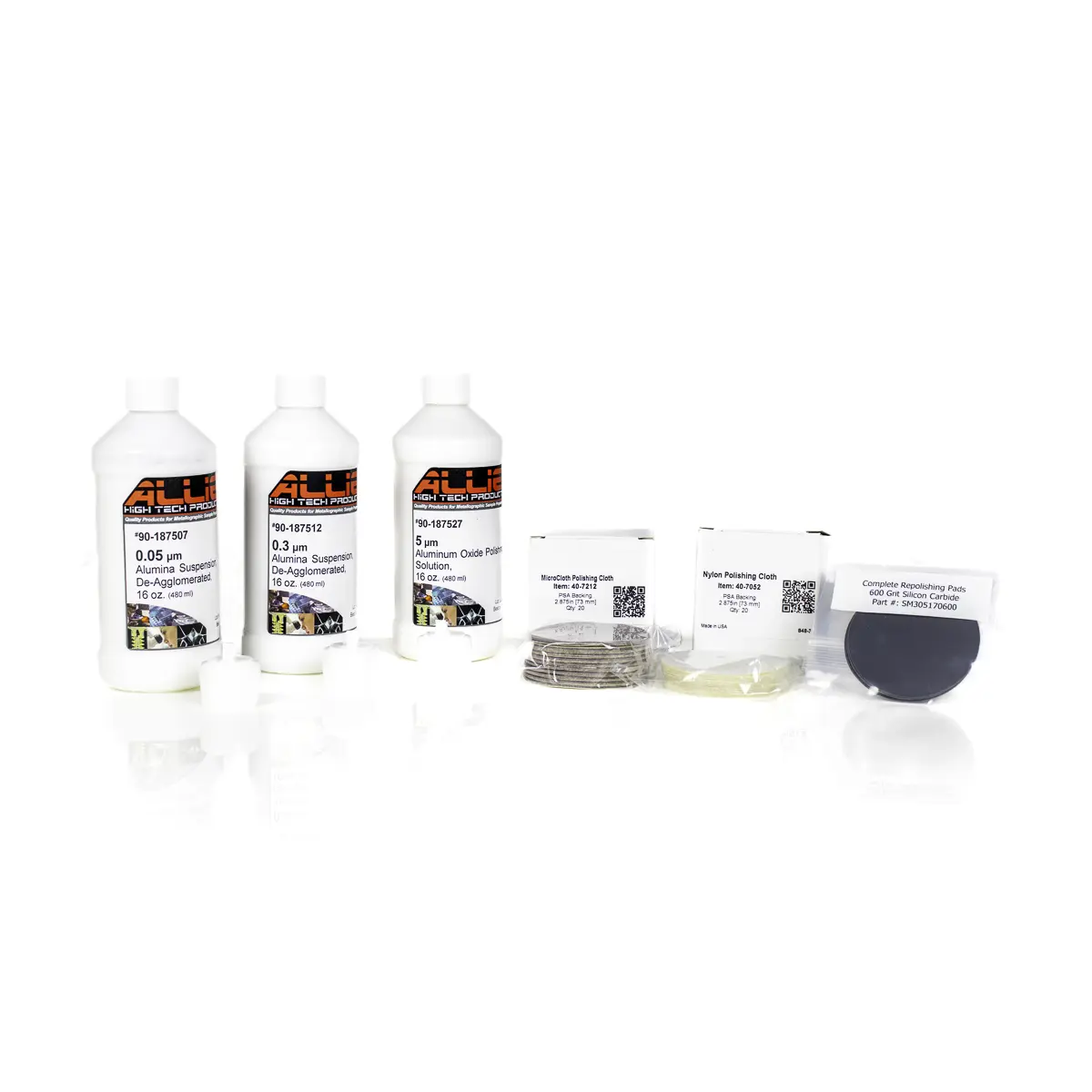
0.3 µm Aluminum Oxide Suspension (Alumina)
0.05 µm Aluminum Oxide Suspension (Alumina)
5 µm Aluminum Oxide Suspension (Alumina)
Grinding Disk

Elemental Metals

Platinum (Pt)

Reference Electrode Filling Solutions

4 M Potassium Chloride with Silver Chloride (KCl with AgCl)

Request a Quote for this Cart

Below is the billing data we have on file. These details will be used on your quotation, so please update them here if you require any changes. Changing any details here updates them for your account.